
The video below shows the two ways you can use a Star Analyser with a DSLR.
Please see this page for further discussion on using DSLRs: link.
Using a standalone DSLR
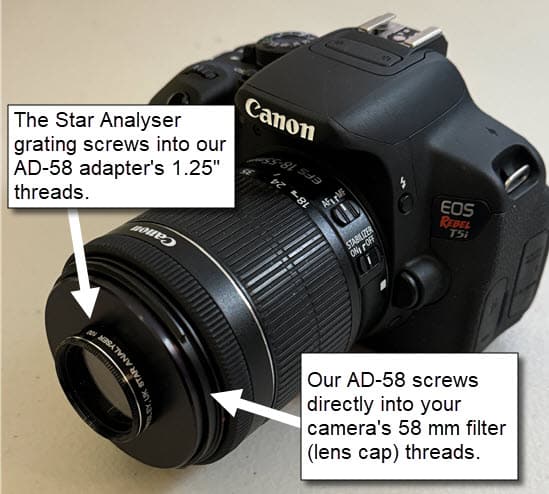
If you’re using a Star Analyser as an objective grating on a standalone DSLR, you do not need to use the Calculator.
You should use our AD-58 adapter. More info on AD-58: link.
Here’s how to determine which grating to use:
• If your lens is between 35 and 100 mm: use a Star Analyser 200.
• If your lens is between 70 and 200 mm: use a Star Analyser 100.
Read more about the AD-58 here.
The advantage of an objective grating setup is that, because the light in the beam from a distant star is parallel, the spectra produced are significantly sharper than those achieved with the grating between a telescope and a camera. In this setup you can gain resolution by lengthening the spectrum. Zooming your DSLR lens can achieve values as low as 2 Angstroms/pixel. (Here you can ignore the high-dispersion warning in the calculator.)
The disadvantage of an objective grating setup is that, because a DSLR’s aperture is considerably smaller than that of most telescopes, it is suitable only for use with bright stars.
Advanced topic: Although it’s not necessary, if you would like to experiment with objective gratings in the calculator, set the Grating To Sensor Distance (Field 5) to the lens’s focal length, and ignore any messages about the focal ratio (Field 2). In this setup, the distance between the grating and the lens does not affect the spectrum. However, it is usually best to mount the grating as close to the lens as possible, to minimize vignetting.
Using a DSLR with a telescope

When you’re using a DSLR with a telescope, you should use a Star Analyser 100 with our AD-T2 T-Ring adapter. For more info on the AD-T2: link.
In the calculator, enter 60 mm for the Grating to Sensor distance.
If the calculator suggests closer spacing, screw the grating onto the camera side of the AD-T2 for 53 mm spacing. Need even closer spacing? Add one or two Star Analyser spacers for an additional 10 mm each.